
The latest policy, research, and news on global catastrophic risk (GCR).
Global catastrophic risk can feel daunting. Its scale can suggest a costly entry ticket. But entering the space does not require full-time employment or deep expertise. It might only take a spare evening and a willingness to dive in. This month proves it. Easiest of all, there are multiple public and online events across the GCR landscape, which we cover in the On the Radar section below. Join one of them! The annual multilateral hubbub in Geneva and New York is taking place, with AI, pandemic preparedness, autonomous weapons, food security and supply chain shocks on the agenda. Pick an area of interest and track the progress! And there is always news and research to digest. In this edition, we cover just two reports – one Global Shield report on AI policy and a UN Environment Programme report on climate change. But there are many more put out every day. Pick one and go deep. Getting involved doesn’t have to start at the level of the problem. It can start with a registration link, a YouTube video, or a podcast episode.
Inside Global Shield
Updates on Global Shield’s work and team.
Australia
Global Shield Australia has released a new report assessing the Australian Government’s shift away from mandatory guardrails on AI towards the use of existing laws to manage AI harms. It comes just as Australia’s Parliament has established a new Joint Select Committee on Artificial Intelligence and tasked it with considering the adequacy of the processes our report reviews.
Director of Global Shield Australia, Devon Whittle, appeared on the podcast Alive to This to discuss catastrophic AI risk, alongside Chair of Global Shield Australia, Dr Arnagretta Hunter, and CEO of Good Ancestors, Greg Sadler. They spoke about many topics, including the awareness-to-action gap for policymakers, AI as an omni-use risk amplifier for cyberattacks and biosecurity, power concentration and the US-China race dynamic, and Australian sovereignty. Overall, they painted a picture of how a middle power like Australia can develop agency rather than drift down a path set by a handful of foreign companies.
Under the lens
A closer look at a GCR policy matter
Food security at the Security Council
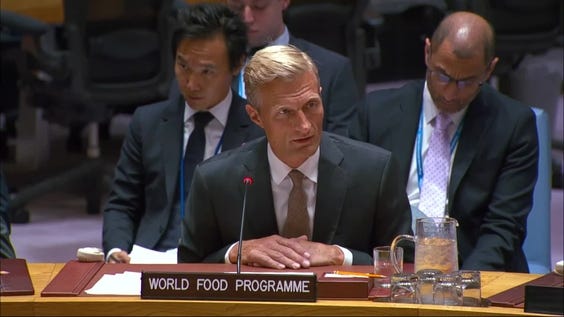
On 26 August, the UN Security Council (UNSC) debated global food security challenges arising from conflict. Denmark, in its capacity as President of the Security Council for the month of August, held the debate under the theme “Food under fire: the Security Council’s role in mitigating global and local food crises.”
Secretary-General António Guterres addressed the UNSC. He called on the Council to consider three measures: implementing resolution 2417 (2018) in full, including acting when early warning systems raise the alarm; protecting the infrastructure essential to food security, from livelihood sources to supply routes; and protecting humanitarian workers and the arrangements that let them operate.
Acting Executive Director of the World Food Programme (WFP), Carl Skau, stated: “Beyond this vicious cycle that we have been warning you for years now, there is a new dimension that needs your attention and your action. Consequences of conflict are now also being transmitted thousands of miles through interconnected economies and trading systems across borders and seas.” Skau illustrated this with what he termed a “triple chokepoint crisis”: disruptions across the Strait of Hormuz, the Red Sea, and, most recently, the Black Sea, each compounding the others’ effects on food prices and shipping costs far from the conflicts themselves.
Policy comment: Despite the focus of the UNSC debate on the role of conflict, the current global food shock is arising from an interplay of security, environmental and political factors. The upcoming “super” El Niño, for example, is expected to bring heavy flooding to drought-ridden Somalia and disrupt monsoon patterns in India. The flash floods in Nepal, which occurred on the same day as the UNSC debate, devastated crops and disrupted essential supply routes. Sri Lanka pointed to its own severe food crisis in 2022 due to a global supply shock and domestic economic collapse. This complex environment is not one in which conflict-only solutions will work for building food system security – as needed as they might be regardless. Countries and regional groupings could look more to build reserve buffers. For example, Malaysia and Vietnam’s delegations pointed to the ASEAN plus Three Emergency Rice Reserve (APTERR), a genuinely novel regional model. Malaysia has also been pushing to expand this cooperation to fertilizer security. Meanwhile, Kazakhstan identified the Islamic Organization for Food Security (IOFS) as an institutional home for coordinating national food reserves across its 43 member states. These efforts not only show the importance of food reserves in case of complex shocks, but also the role that regional organizations are playing in operationalizing them.
Global tipping point risk
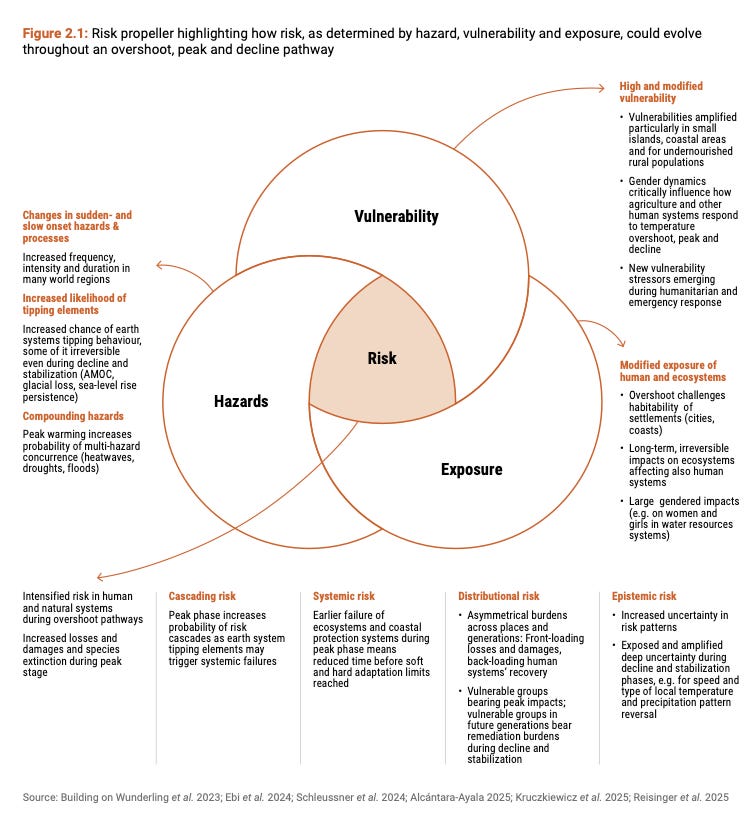
The United Nations Environment Programme (UNEP) has released a report on the implications of overshooting 1.5°C of warming above pre-industrial levels. “There are no good outcomes if we remain above 1.5°C,” said Inger Andersen, Executive Director of UNEP. “Across the globe, extreme heatwaves are already proving that climate impacts will strike faster, hit harder, and last longer, costing more lives and causing deeper disruption.” The report anticipates that intensified extreme weather, ecosystem loss, and severe damage to human health, food security, water supplies, and infrastructure will follow.
The report notes that “There is also a higher risk of irreversible tipping points to global systems such as the West Antarctic and Greenland ice sheets, the Atlantic Meridional Overturning Circulation (AMOC) and the Amazon rainforest — which would reshape the world forever.”
Zero Carbon Analytics also assesses that climate tipping points remain a concern even though the worst-case trajectory of emissions (known as RCP8.5) has been retired. At different levels of warming, different tipping points are exposed: at 1.5°C, Greenland ice sheet and Antarctic ice sheet; at 2°C, North Atlantic subpolar gyre and mountain glaciers; at 3°C, West African monsoon and East Antarctic marine basins; at 4°C, Boreal forests and the AMOC.
Forecasters are separately tracking a record-strength El Niño event expected to peak by December 2026, potentially the most intense on record. Global annual losses from climate-driven disasters are estimated at approximately USD 450 billion, less than half of which is insured, leaving governments and communities to absorb the remainder.
Policy comment: With climate experts assessing that 1.5°C of warming is inevitable, the risk of climate tipping points can no longer be taken as speculative. However, despite at least 20 years of active study and 10 years of academic mainstreaming, climate tipping points receive little policy attention, let alone action. Their uncertainty is too much for policymakers to grapple with. COP31, co-hosted by Türkiye and Australia, would be the ideal forum to spawn a discussion. Tipping points have so far entered COP proceedings only through scientific side events, not through the formal discussions or negotiations. Territories and communities most vulnerable to tipping points – such as countries near the Arctic, Antarctic and Amazon – could take the lead. But tipping points are a case in point of how to advance policy thinking on global catastrophic risk. Risk needs to feel present and relevant. Efforts to highlight local and regional tipping points would resonate because they are both likelier and closer to home.
On the Radar
Upcoming events and activities that we are tracking.
Cambridge Conference on Catastrophic Risk
The Centre for the Study of Existential Risk (CSER) is hosting the Cambridge Conference on Catastrophic Risk on 17–18 September. It aims to bring together the existential risk community, with a focus this year on the governance challenges shaping today’s world. Panels will be held on governing catastrophic climate risk, AI and emerging technologies, geopolitics and nuclear weapons, and the future of pandemic preparedness. The conference will open with a free online public lecture by Professor Max Tegmark (MIT), A Better Path for AI, on Wednesday 16 September. The lecture is open to everyone, but advance registration is required.
World Risk Poll Resilience Index
Lloyd’s Register Foundation (LRF) is hosting the launch of the 2026 World Risk Poll Resilience Index on 13 October, landing on International Day for Disaster Risk Reduction. Built using data from the LRF World Risk Poll spanning 140 countries, the Index measures resilience at four levels – individual, household, community, and societal. The event will look at the trends shaping global resilience across the past five years and deep-dive into the latest World Risk Poll data on the coverage of disaster early warning systems. Online registrations can be found here.
Global Shield’s Global Growth and Development Manager will be in attendance.
Multilateral agenda
September sees a packed multilateral agenda. In New York, the 81st session of the UN General Assembly opened on 8 September, with high-level week over 22–28 September, including the Second High-Level Meeting on Pandemic Prevention, Preparedness and Response on 25 September and a Secretary-General-convened Climate Summit on 23 September. In Geneva, the Group of Governmental Experts on Lethal Autonomous Weapons Systems met 31 August to 4 September, amid the push for a legally binding instrument on autonomous weapons this year. The eighth meeting of the Intergovernmental Working Group on the Pathogen Access and Benefit Sharing annex runs 14–18 September, which is needed for the completion of the Pandemic Agreement after the missed May deadline. In Vienna, the International Atomic Energy Agency holds its 70th General Conference over 14–18 September.
Global Shield’s Executive Director will be in New York for UNGA side events during the week of 22 September.
Global Tipping Point Conference
The Global Tipping Points Conference 2026 will be held on 12–15 October. It is being hosted by Sunway University, Kuala Lumpur, Malaysia. It convenes scientists, policymakers and practitioners on Earth system tipping points. Key themes include planetary boundaries science, Asia’s role in accelerating systemic change, and positive tipping points in energy, finance, health and governance.
Global Shield will attend in a virtual capacity.
Mirror life conference
The Singapore Conference on Mirror Life will be held on Monday 28 September 2026. According to a recent RAND report, “Mirror life is a governance challenge without precedent; even earlier crises, such as pandemics and widespread conflict, do not compare with the potential catastrophic effects of the creation of mirror life.” The online conference brings together senior experts from Singapore and the international community to discuss the policy implications of mirror life. It is being co-hosted by the Asia Centre for Health Security, the Singapore Consortium for Synthetic Biology (Sinergy), and the Synthetic Biology for Clinical and Technological Innovation (SynCTI), with organizing support from the Mirror Biology Dialogues Fund.
This briefing is a product of Global Shield, an advocacy organization dedicated to reducing global catastrophic risk of all hazards. With each briefing, we aim to build the most knowledgeable audience in the world when it comes to reducing global catastrophic risk. We want to show that action is not only needed, it’s possible. Help us build this community of motivated individuals, researchers, advocates and policymakers by sharing this briefing with your networks.