

The latest policy, research and news on global catastrophic risk (GCR).
In this edition, we look at how governments from the EU to Japan are asking households to prepare for the first 72 hours of a crisis, and why keeping essential services running after that depends on governments and industry. We also cover the converging shocks facing the global food system. Also inside: Australia’s new AI safety regulator, the 11 December deadline for the US Defense Production Act, our new partnership with REAP, and the race for the next UN Secretary-General.
Inside Global Shield
Updates on Global Shield’s work and team.
Australia
On 10 November, Prime Minister Anthony Albanese announced proposals for new mandatory AI safety and security protections for frontier AI companies operating in Australia. These protections will be legislated through the forthcoming AI Standards and enforced by a new AI safety regulator. Companies will have to identify and manage serious risks from their models and notify the Government rapidly of incidents. The Government also accepted all 18 recommendations of the Rapid Review into the AI-driven cyber incident affecting Services Australia. Several of these measures reflect what Global Shield Australia has been calling for, including mandatory AI incident reporting.
“The Services Australia incident showed that Australians can’t just hope that AI companies will do the right thing,” said Devon Whittle, Australia Director. Getting the details right is the next test: companies must be required to monitor for incidents, not just report the ones they happen to detect. Read our press release, our proposal for AI incident monitoring and reporting and share our post on LinkedIn.
The Prime Minister’s announcement follows Global Shield Australia’s evidence to the Joint Select Committee on Artificial Intelligence in Sydney on 6 October, where we warned that AI is giving malicious actors new capabilities to develop biological agents and weapons, and called for mandatory incident reporting and screening of imported synthetic DNA. On 12 October, the Committee wrote to the Prime Minister to provide its recommendations on incident reporting and addressing biological risk. The Government says its new protections are aligned with the Committee’s recommendations. Read our submission to the Committee.
Coming up: the Parliamentary Joint Committee on Defence is running an inquiry into national civil preparedness and resilience. Submissions will close on 27 January, and Global Shield Australia is developing a comprehensive report to inform the inquiry.
United States
The Defense Production Act. The DPA’s core authorities expire on 11 December, and Congress is expected to deal with them in the final defense bill during the lame duck session. An extension looks likely. The bigger question is whether Congress also updates the law so it works in a real crisis. Today, the government has no fast way to plan with industry before a crisis. During COVID-19, setting up a single planning agreement took about four months.
A bipartisan fix is ready. A modernization package, H.R. 7688, cleared the House Financial Services Committee 41 to 0, and the White House has asked for a DPA that is “faster, nimbler, and better-resourced.” Global Shield is working to make sure that update makes it into the final bill. Read our state of play.
Multilateral
Global Shield has joined the Risk-informed Early Action Partnership (REAP), a global network of more than 100 partners across the climate, humanitarian and development communities working to turn early warning into early action. As a REAP partner, Global Shield will bring an all-hazards perspective, with a focus on cascading, catastrophic risks, and will share policy expertise to help embed early warning, anticipatory action and preparedness in national policy and multilateral processes, including the UN’s work on complex global shocks. Read the announcement.
Complex global shocks. On UN Day, we marked Secretary-General Guterres’s last UN Day in office. Two years ago, Member States asked him to strengthen the UN’s response to complex global shocks in Action 54 of the Pact for the Future. That work has still not been delivered. On complexglobalshocks.org, our two snapshots show how COVID-19 and the food, energy and finance crisis that followed Russia’s full-scale invasion of Ukraine played out as complex global shocks. Others are making the case too: the UN Foundation backed UN action on complex global shocks in Devex.
NATO
Our Director of NATO Policy, Jobe Solomon, traveled to Tallinn to meet government officials and think tank experts, and attended the Defending Baltics conference in Vilnius. Across both cities, the urgency was hard to miss: officials are taking total defense and preparedness seriously given the acute military threat. Estonia follows the Finnish model of comprehensive security, assigning a ministry to coordinate each vital service across government and the private sector, while Lithuania has adopted lessons from the Ukrainian city of Kharkiv on civil defense.
With Allies committed to spending up to 1.5 percent of GDP a year on resilience, Global Shield is working with governments and infrastructure operators to make sure that money buys real capability against NATO’s Baseline Requirements for Resilience.
Team

Global Shield Australia is looking for a Deputy Director or Senior Associate to help lead its policy work in Canberra in 2027, with a focus on AI risk alongside critical infrastructure, biosecurity, food security and emergency management. We would love to hear from people with experience in Australian politics, federal policymaking or think tanks. Applications close 20 December and are reviewed on a rolling basis.
Under the lens
A closer look at GCR policy matters
Preparedness goes mainstream

Governments across the world are asking their populations to get ready for crises:
EU: on 3 November, the European Commission published new population preparedness guidelines for Member States, covering risk communication and how to help people be self-sufficient for at least 72 hours. It also plans an annual EU Preparedness Day every 23 October from 2027.
Japan: the new National Disaster Management Agency launched on 2 November, and its minister issued emergency requests for residents to stock water and portable toilets for at least three days.
United Kingdom: the Government launched its “Be Ready” campaign on 22 October, asking households to keep three days of food, water and cash. On 16 November, the House of Lords National Resilience Committee published its report, finding the country underprepared for several crises at once and calling for a Cabinet minister solely responsible for national resilience.
Germany: LÜKEX 26, Germany’s largest ever civil protection exercise, tested the response to drought and a 45°C heatwave from 4 to 6 November. Earlier this year, Germany’s new civil defense plan chose everyday shelters, such as underground parking garages and subway stations, over new bunkers.
Finland: the Ministry of the Interior will mail a printed preparedness guide to about 3.5 million households and businesses in January, and Finland has published its national risk assessment 2026. On 17 November, it also tested FI-Alert, its new emergency warning system for mobile phones.
Policy comment: The most resilient countries are those where ordinary citizens are prepared to provide for themselves, their families, and support their neighbors in the immediate aftermath of a crisis. People who do not know the threats will underprepare, and pay for it in lives, property and livelihoods when a crisis hits. That makes communication and education the foundation of increasing individual and community-level preparedness. Sweden, Norway and the Netherlands have studied their own household campaigns and found what works: repeat the advice regularly, use several channels at once, keep it actionable and affordable, and be frank about both the threats and the limits of what governments can do.
However, no matter how prepared you can make your population, that preparedness has its limits if critical infrastructure cannot be maintained or quickly restored. A country runs on its critical infrastructure: power, water, hospitals, telecoms and supply chains, most of it owned and operated by the private sector. Operators, businesses, insurers and investors also need clear information about national risk, and a defined role in national plans and exercises. Preparedness that stops at the front door leaves out most of what keeps a country running. It has to involve the whole of society.
When crisis ends up on the dinner table
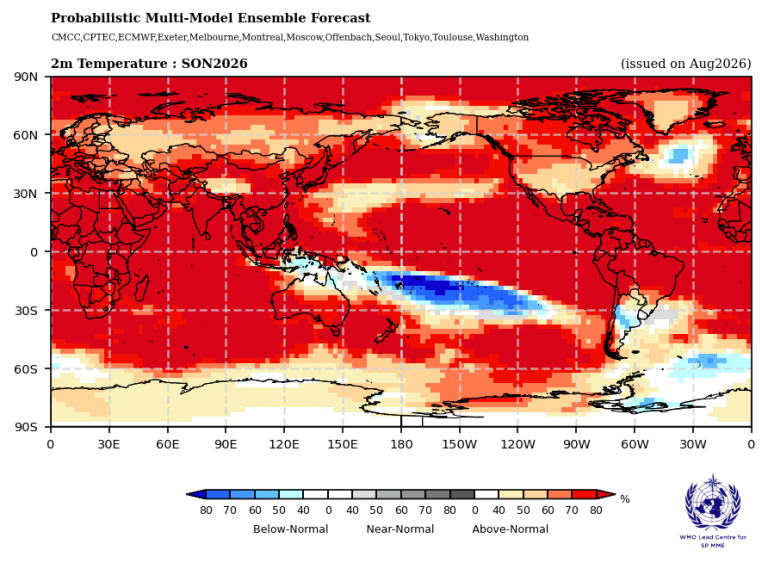
Several shocks are converging on the global food system at once, while preparedness lags behind:
A chokepoint for fertilizer. On 14 October, a UN official warned that parts of Asia and Africa could face a food crisis if a UN plan to move fertilizer through the Strait of Hormuz is not activated before the planting season.
A very strong El Niño. The WMO puts the chance of El Niño lasting through February 2027 at nearly 100 percent, with droughts and floods expected to grow as it peaks. Prices are already up: world food prices in October were 5.9 percent higher than a year earlier, according to the FAO.
Some governments are responding. In October, the UK set up a Food Preparedness Group to ready the food system for severe disruption, including catastrophic risks such as widespread infrastructure failure.
But food is still a blind spot. The Council on Strategic Risks’ landscape assessment of EU food security and climate resilience (29 October) finds that food security “remains a fringe topic” in EU and NATO cooperation, even though NATO’s Baseline Requirements for Resilience already list the continued supply of food and water as one of the standards every Ally should meet. Global Shield has flagged food as a weak point for years, most recently in our snapshot of the food, energy and finance crisis.
Policy comment: Almost every global crisis ends up affecting food systems. A heatwave kills the harvest, a conflict closes a shipping lane, a cyberattack or power cut brings ports and cold stores to a standstill. The causes differ, but the result is usually the same: empty shelves and higher prices. And the burden is never shared equally. Households that already spend most of their income on food, smallholder farmers with no buffer, and import-dependent countries with little fiscal space are hit first and hardest, and often take years to recover. A shock that is a political and economic inconvenience in one country can push millions into acute hunger in another.
That makes global food supply security a preparedness issue, not just an agricultural or humanitarian one. Being ready means acting before the shock: using early warning to trigger anticipatory action, building social protection systems that can scale up quickly when prices spike, keeping reserves of what matters, and planning with farmers, retailers and logistics firms, not around them. Every dollar spent preparing goes further than one spent responding, and it protects the people who have the least room to absorb the next crisis.
On the Radar
Upcoming events and activities that we are tracking.
UN Secretary-General succession
At the eighth straw poll on 5 November, Rebeca Grynspan extended her lead with 12 encourage, 3 discourage and 0 no opinion votes. Rafael Grossi stayed second (9, 4, 2), and the UAE’s Lana Nusseibeh placed fourth (7, 6, 2). The ballots did not show how the five permanent members voted, so it is still unclear whether Grynspan has their backing. Türkiye’s Feridun Sinirlioğlu joined the race on 1 November, and Council members may return to color-coded ballots, which reveal permanent members’ votes, in the next round. Guterres’s term ends on 31 December. Our ask: the next Secretary-General’s first 100 days should deliver Action 54 on complex global shocks.
COP31
COP31 is under way in Antalya until 20 November, with Türkiye hosting. Climate change multiplies other risks, from food insecurity to conflict and displacement, so adaptation and preparedness belong in the same conversation as cutting emissions.
The EU plans for a 3°C world
On 27 October, the European Commission presented a Climate Resilience Framework and proposed a European climate resilience law, asking Europe to prepare for up to 3°C of warming by 2100.
Pandemic preparedness
The UN political declaration on pandemic prevention, preparedness and response, adopted on 12 October, passed by vote rather than consensus: 153 for, 3 against (Argentina, Israel and the United States) and 2 abstentions (New Zealand and Paraguay). Meanwhile, the WHO Pandemic Agreement still cannot open for signature until its annex on pathogen access and benefit sharing is agreed, which advocates want done by May.
AI incident reporting is spreading
Australia is not alone in asking AI companies to report when things go wrong. On 28 October, at a virtual Leaders’ Meeting on Frontier AI Safety co-hosted by Norway and Finland, Singapore’s Prime Minister Lawrence Wong proposed an international pilot for sharing reports of serious AI incidents and near misses, modeled on aviation. And ahead of the EU’s first AI summit on 13 November, Finland and Estonia called for EU-level arrangements to respond to serious AI incidents.
The UK backs an AI biosecurity lab
On 24 October, the UK announced a £165 million National AI Biosecurity Initiative, including £100 million for a new AI Biosecurity Lab to detect and monitor biological threats. OpenAI and Anthropic committed “up to” £200 million, mostly in model and compute credits rather than cash.
How the world sees risk
The Lloyd’s Register Foundation World Risk Poll 2026, based on about 143,000 interviews in 140 countries, found that 75 percent of people see climate change as a serious threat to their country, the highest level since the poll began in 2019. Harm from food and drinking water also rose to its highest level since 2019. It is a useful reminder that preparedness starts with how people understand risk.