
The latest policy, research, and news on global catastrophic risk (GCR).
As the world lurches from one shock to another, the underlying drivers of global risk keep moving. Like earthquakes, we feel the sudden shifting of the tectonic plates, not their slow grind under our feet. But when shocks are frequent and disruptive, it becomes almost impossible to focus on the long-term trends. And while crises have often been a burning platform for change, polycrisis can become overwhelming. This crisis-response cycle only makes the next major shock more likely and more harmful. The cycle must be broken, with longer outlooks, systemic fixes, and a resilient society that can bend without breaking.
Inside Global Shield
Updates on Global Shield’s work and team.
Global Shield is pleased to welcome three new staff. Laura Cirillo Edwards and Clay Huddleston are joining the US office to strengthen our US policy advocacy to reduce global catastrophic risk. Tasia Ghiselin is joining as our Operations Manager.
Laura is an accomplished public policy and communications leader, with deep experience in emergency management and homeland security. Laura will lead catastrophic risk and resilience advocacy for Global Shield US, including the implementation of the Global Catastrophic Risk Management Act and reforms to the Federal Emergency Management Agency (FEMA).
Clay has background in defense and national security advisory roles, including the Department of Defense and the US Congress as a defense policy advisor. Clay will lead advocacy on national security and emerging threats for Global Shield US, including on the Defense Production Act.
Tasia Ghiselin is an operations and project management professional with over a decade of diverse experience spanning non-profit global operations, education, and administrative leadership. Tasia will lead Global Shield operations, using her experience to help our team reach our global impact with efficiency.
NATO
Jobe Solomon, Director of NATO Policy, participated in the London Defence Conference (10–11 April) and the inaugural Stockholm Civil Defence Forum (21–22 April). The two conferences were held in a context of a more volatile geopolitical environment – ongoing tensions with Iran, sustained Russian aggression, and increasing transatlantic uncertainty – reinforcing that readiness and resilience can no longer be postponed. A clear and consistent conclusion emerged: political will is no longer the primary constraint. The Alliance’s 1.5% of GDP resilience commitment is in place, but without agreed definitions, common standards, and measurable benchmarks, it risks becoming another unfulfilled pledge. Sweden and Finland are setting the pace. In early June, Jobe Solomon and Global Shield’s Executive Director, Jared Brown, will head to Brussels to continue the conversation with key government and industry stakeholders to press for concrete actions ahead of the NATO Summit in Ankara in July 2026.
International
Laura Starling, Global Growth and Development Manager, recently represented Global Shield in the Asia Futures Forum (25 March), European Futures Forum (24 April) and Africa Futures Forum (5 May). These discussions were organized as part of the Coalition for the UN We Need (C4UN) Regional Futures Forum process. They are an opportunity for civil society organizations to share ideas and reflections on the future of the multilateral system in the context of the UN80 reform process and the implementation of the Pact for the Future. Global Shield will continue to engage in civil society forums to promote efforts that improve United Nations system response to complex global shocks, a key action under the Pact for the Future.
Under the lens
A closer look at a GCR policy matter
Preparedness for climate tipping points – among other catastrophic threats
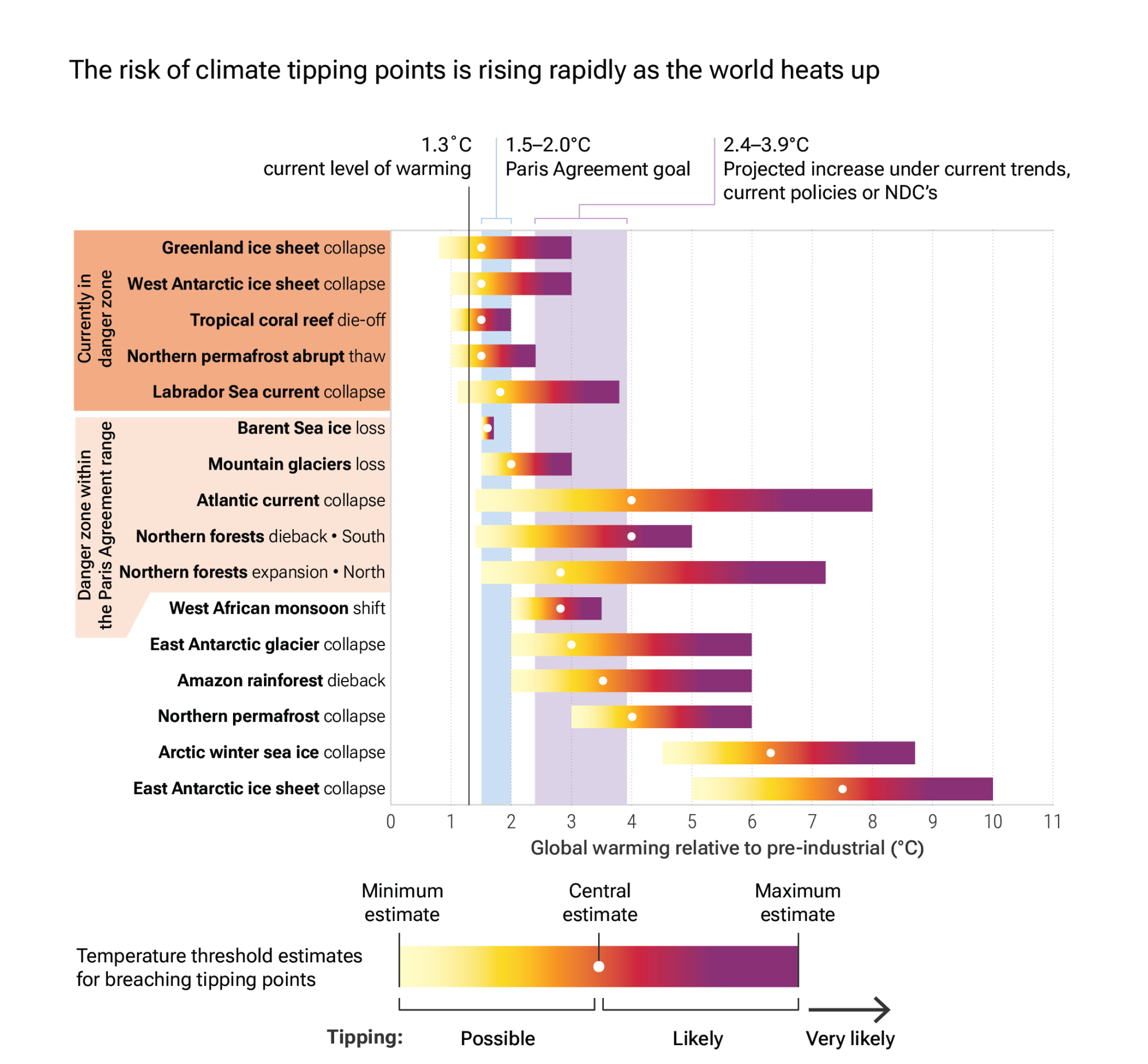
A set of new studies have been published relevant to climate tipping points. New modeling of the Atlantic Meridional Overturning Circulation (AMOC), a global tipping point, estimates that AMOC slowdown is about 50 per cent likely by 2100. A group of climate and meteorological experts have called for an AMOC early warning system as well as societal preparedness.
The global head of climate advisory for a major bank, JP Morgan, has released a new report on the science behind climate tipping points, the importance of pricing them in and approaches to making decisions under deep uncertainty. The report suggests potential actions for policymakers including “Analyze food, water, infrastructure resilience to tipping” and “Secure critical supply chains”.
A new report by the Institute and Faculty of Actuaries and the Anglia Ruskin University calls on policymakers, actuaries and financial institutions to integrate nature risk into economic models, national security strategies and investment decisions. It considers tipping point risk from deforestation, pollinator collapse and marine biodiversity.
A new study by the Grantham Research Institute on Climate Change and the Environment shows that “more extreme disasters are, under identifiable conditions, less likely to produce mitigation policy rather than more.” This outcome occurs because large disaster shocks temporarily slow down policy efforts to mitigate risk while tightening economic resources for long-term responses.
Policy comment: This cluster of new research on disaster risk and climate tipping points arrives just as the world is distracted by other current crises. Geopolitical flashpoints and their second-order economic shocks are systematically crowding out the political and fiscal capital needed to prevent global catastrophic risk. The very conditions that make prevention urgent are also those most likely to hinder it. Severe crises consume budgets and attention, compress political time-horizons and redirect policy bandwidth. In a world of increasing systemic and complex risk, the result could be a dangerous cycle. Each shock defers the investments that would reduce exposure to the next one, while the underlying risk continues to accumulate. It should therefore not be a surprise that the climate change researchers and analysts quoted above emphasize policy responses focused on societal preparedness, supply chain security, and resilience of food, water and infrastructure sectors – important and useful actions for a range of catastrophic threats, not just climate tipping points. With so many threat vectors facing countries in the next few decades, we need to focus on policy solutions that address multiple threats at once.
On the Radar
Upcoming events and activities that we are tracking.
“Are we doomed?”
On 28 April, NPR launched a weekly podcast series, called “Are we doomed?”, that investigates the threats that haunt humanity. The first two episodes are on AI risk and nuclear war. Upcoming episodes will explore incorrect predictions of catastrophe in the 20th century, as well as societal collapse.
Candidates for UN Secretary-General
Global Shield is following the process of selection and appointment of the next Secretary-General and its impact on the implementation of the Pact for the Future. On 21 and 22 April, the candidates participated in an interactive dialogue session at UNGA (available here).
Biosecurity funding
Coefficient Giving is inviting short expressions of interest to support work in the field of biosecurity. They expect to direct over $100 million this year. The areas of particular interest are: transmission suppression, technological safeguards and governance, policy and advocacy, and field-building. The applications will close on 11 May at 11:59pm PT.
This briefing is a product of Global Shield, an advocacy organization dedicated to reducing global catastrophic risk of all hazards. With each briefing, we aim to build the most knowledgeable audience in the world when it comes to reducing global catastrophic risk. We want to show that action is not only needed, it’s possible. Help us build this community of motivated individuals, researchers, advocates and policymakers by sharing this briefing with your networks.