
The latest policy, research, and news on global catastrophic risk (GCR).
As geopolitical competition and technological progress continue to outpace international coordination, we see the perception of risk being mismatched from reality – a widening gap between escalating threats and actual national and international readiness. Like the proverbial frog in slowly heating water, governments have grown dangerously comfortable in an environment of compounding risks. As traditional multilateral frameworks – such as the Nuclear Non-Proliferation Treaty (NPT) – struggle to find solutions, the burden of resilience is shifting more and more towards national and local leadership. Governments cannot afford to wait for global consensus to proactively invest in preparedness and resilience, or we risk being caught in the boiling water.
Inside Global Shield
Updates on Global Shield’s work and team.
Australia
Global Shield Australia has continued its advocacy for Australia to better address the threat posed by AI-enabled bioweapons, with a particular focus on reforms to Australia’s biosecurity import permit regime to restrict the importation of dangerous DNA sequences. The Australian office’s recent efforts included joining an open letter to the Minister for Agriculture, Fisheries and Forestry, supporting a related postcard campaign with the Uniting Church of Australia and other advocacy organisations, and engaging in government consultations on biosecurity reforms. The office is also engaging with Australia's Department of Foreign Affairs and Trade on the country’s upcoming international AI engagement strategy, advocating for effective action to support regional and global efforts to reduce catastrophic AI risk.
US
Global Shield’s US office is closely tracking and engaging on recent developments with the Federal Emergency Management Agency (FEMA). These include:
On 7 May, the FEMA Review Council released its final report, which made a number of recommendations on improving disaster response across the country. The Council recommended a major shift in disaster leadership back to states, tribes, territories and local governments, with the federal government moving into a more supporting role. Similarly, the FEMA Act of 2025, a House bill currently with over 50 co-sponsors, would make major reforms to how the agency manages disaster assistance projects.
There is also ongoing implementation of Executive Order 14239: Achieving Efficiency Through State and Local Preparedness, from the Trump Administration, that could further revise U.S. emergency management policymaking for all disasters, including those of a global catastrophic nature.
With the nomination of Cameron Hamilton to serve as the next FEMA Administrator, pending confirmation by the U.S. Senate, and with Secretary Mullin now in place at the Department of Homeland Security, the United States is entering a consequential period in emergency management policy. Global Shield’s US office looks forward to engaging on these issues, which we hope will lead to fundamental improvements in preparedness for global catastrophes.
Under the lens
A closer look at a GCR policy matter
Latest perceptions of global risk
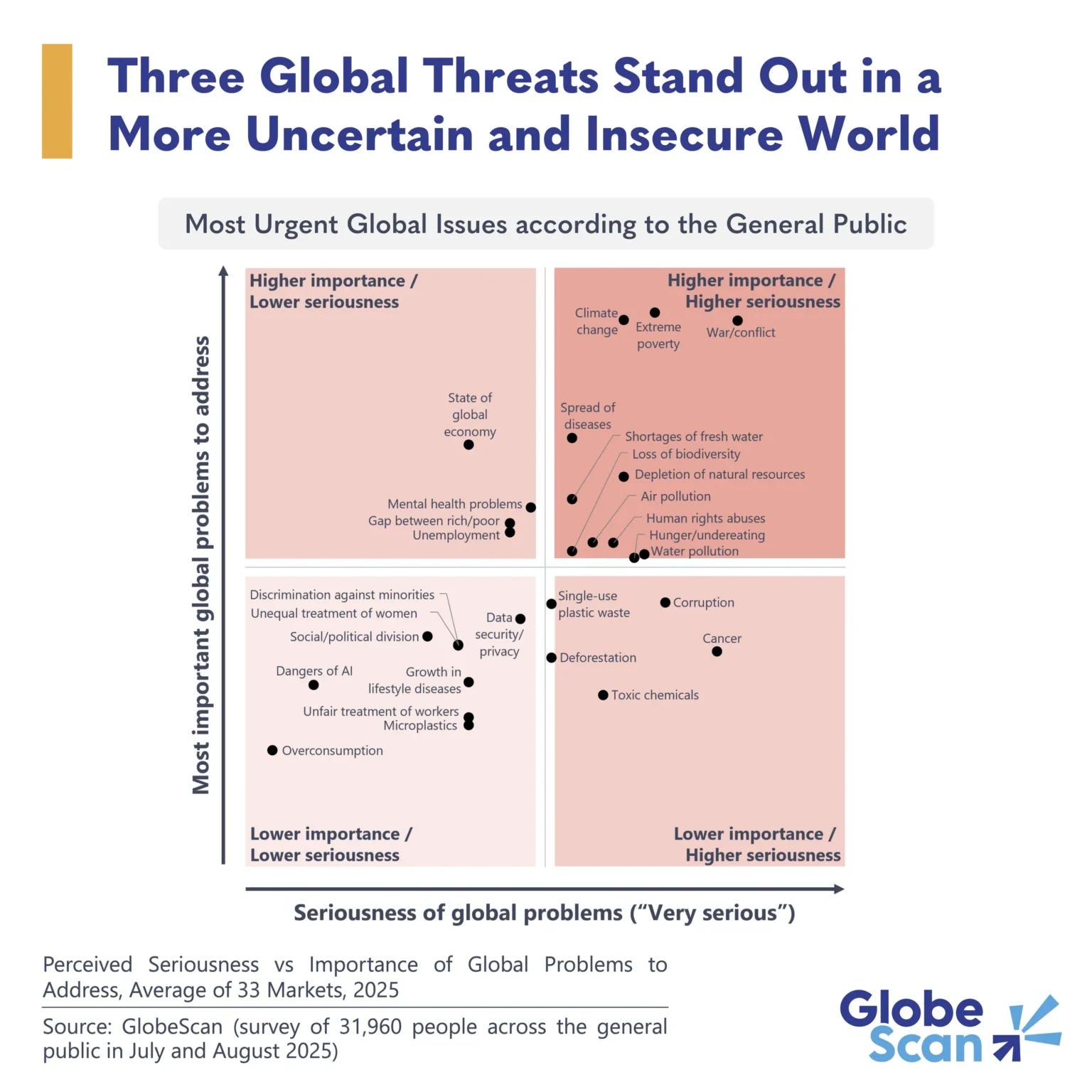
Over the past few months, a number of research organizations, investment and polling firms have released reports on public and corporate perceptions of global risk, including their urgency and institutional preparedness.
GlobeScan – a global polling firm – surveyed nearly 32,000 people across 33 countries (including Australia, Brazil, Germany, India, Japan, Sweden and the UK) about the seriousness and importance of global problems. According to the report, war and conflict, climate change, and extreme poverty “form a distinct top tier of perceived urgency”. Public health risks, governance issues and environmental problems beyond climate change were the next tier of seriousness and urgency.
Global Citizen Solutions – a global mobility organization helping individuals move around the world and obtain employment – published the Global Atlas of Risk and Readiness Report (GARR) 2026. The GARR framework ranks countries based on their exposure and readiness to global shocks. Leading the rankings as best – combining low risk exposure with high readiness – were Switzerland, Germany, Singapore, Ireland, Finland, Denmark, Netherlands, United Arab Emirates, and Australia.
The Crisis24/Harris Poll surveyed 303 senior US business leaders on their organization’s approach to crisis planning. According to the poll, every respondent described their approach as “proactive”. But “93 percent admitted their company had missed warning signs of crises or disruptions, with one in four saying it happens frequently or all the time.”
The BlackRock’s Geopolitical Risk Dashboard tracks the top geopolitical risks for its investing audience. Middle East regional war, global technology decoupling, major cyber attacks, major terror attacks, and Western Hemisphere tensions were ranked the five most likely.
Policy comment: The gap between global risk and national readiness continues to grow. Indeed, national leaders, much like the CEOs in the Crisis24/Harris Poll, are probably overestimating their readiness. Even countries that appear to be ready and resilient, like Switzerland, Singapore and Finland, cannot be complacent. Indices and rankings offer no refuge in a real crisis. Take the COVID-19 pandemic. In 2019, the Global Health Security Index ranked the US and the UK as the top two countries for dealing with a health emergency, including “rapid response and mitigation”. But, in reality, they performed relatively weakly compared to peers. The overwhelming message – from these recent reports and from recent history – is that crisis readiness is fundamentally a test of leadership. Leaders must honestly assess the risk and their own resilience, build institutions that can nimbly and effectively respond to crises, and take bold action when required.
Also see:
The Accelerator for Systemic Risk Assessment (ASRA) has published a new academic article on a set of principles for applying systemic risk governance.
Nuclear
Between April 27 to May 22, 2026, the 11th Review Conference of the Treaty on the Non-Proliferation of Nuclear Weapons (NPT RevCon) took place at UN Headquarters in New York. The conference happens every 5 years to assess the NPT’s implementation and progress, and marked the third consecutive one that failed to achieve a consensus outcome.
The Bulletin of the Atomic Scientists has launched a series revisiting nuclear winter research, motivated by a convergence of new developments: a National Academies report on nuclear war’s environmental impacts, a first-of-its-kind forthcoming UN scientific panel, and advanced climate models offering fresh insight into the global effects of nuclear war.
A new Chatham House report focuses on the deterioration of arms control and the possibility of a new nuclear arms race. It recommends re-establishment of strategic stability dialogues, engagement around new technologies, and investments in maintaining expertise.
New research explores the psychological aspect of nuclear decision-making. The authors note that “the future of nuclear restraint depends on ensuring that leaders and their advisors fully grasp the nature of nuclear threat and that its consequences remain vivid and psychologically coherent.”
Policy comment:
The failure of the NPT conference to reach consensus is representative of the broader multilateral system across all manner of threats. Geopolitical competition and technological progress is putting pressure on nuclear-armed states to expand and modernize their arsenals. And the lack of coordinated international pressure is removing one major constraint. Ultimately, and concerningly, governments need to build resilience and response capacity now, even in the absence of global consensus. For example, on 18 May, the Germany Cabinet approved spending of 10 billion euros by 2029 on civil defence. This spending – under a new Pact for Civil Protection – includes an upgraded medical infrastructure to deal with mass casualties, special vehicles, portable cots, shelters, and mass alerting networks.
On the Radar
Upcoming events and activities that we are tracking.
Global health crisis
An Ebola epidemic has been declared a public health emergency of international concern, with over 746 suspected cases and at least 176 deaths reported across the DRC and Uganda as of 21 May. An Andes hantavirus linked to the cruise ship MV Hondius has been confirmed across 23 countries, with 10 confirmed cases and 3 deaths reported as of 24 May. A new report by the Global Preparedness Monitoring Board finds that “infectious disease outbreaks are becoming more frequent and more damaging, economic impacts are growing, and equitable access to vaccines and treatments has actually gotten worse since COVID-19 – not better.”
Super El Niño
NOAA is forecasting that El Niño is likely to emerge soon – with an 82 per cent chance in May-July 2026 and a 96 per cent chance of it persisting to December 2026-February 2027. A very strong event – dubbed a “super El Niño” – is possible though uncertain. It would exacerbate drought-like conditions in Southeast Asia and Australia and a weaker monsoon season in South Asia, which would reduce rice, grain, sugar, and palm oil production. Combined with the conflict-induced trade restrictions in the Middle East, it would increase food insecurity and food prices.
2026 World Risk Poll launch event
On 23 June, the Lloyd’s Register Foundation and the United Nations Development Programme (UNDP) are hosting an event to launch the first report of the 2026 World Risk Poll. For online attendance, register here.
This briefing is a product of Global Shield, an advocacy organization dedicated to reducing global catastrophic risk of all hazards. With each briefing, we aim to build the most knowledgeable audience in the world when it comes to reducing global catastrophic risk. We want to show that action is not only needed, it’s possible. Help us build this community of motivated individuals, researchers, advocates and policymakers by sharing this briefing with your networks.