
The latest policy, research, and news on global catastrophic risk (GCR).
Humanity’s greatest challenges are no longer over-the-horizon. Food insecurity. Conflict. AI. Climate shocks. They are at our shores. The problem is, a fog obscures their proximity and their magnitude. This edition of the Global Shield Briefing is fundamentally about anticipatory governance. That is, building the institutions and capabilities to act when a crisis occurs, not improvising and re-inventing during the crisis. Our infrastructure, industrial production, supply chains, research capabilities, governing bodies – all parts of society must be ready.
Inside Global Shield
Updates on Global Shield’s work and team.
Australia
Global Shield Australia made a submission to Australia’s Senate Inquiry into Artificial Intelligence and Data Centres, continuing our advocacy to have data centres and frontier AI models covered under Australia’s Security of Critical Infrastructure Act 2018 (SOCI Act). Coverage under the SOCI Act would make these facilities subject to a range of risk management and reporting obligations, along with significant government oversight powers to respond to potential incidents.
US
On 11 June, President Trump signed a Presidential Determination invoking Defense Production Act (DPA) Section 708, directing the Secretary of War to establish “voluntary agreements and plans of action to help provide for the national defense” and address the systemic constraints in the munitions industrial base. With DPA authorization set to expire September 30, 2026, Global Shield’s US office is engaging in the National Defense Authorization Act for Fiscal Year 2027 (FY27 NDAA) reauthorization process as a window for meaningful modernization of the statute from 1950.
NATO
Global Shield’s NATO Policy Director Jobe Solomon and Executive Director Jared Brown met with Allied delegations, NATO and EU institutional staff, and associations representing critical infrastructure entities. These conversations confirmed that the political will to implement the 1.5% pledge is real – but how the money will be spent and tracked remains an open question. On 26 June, Global Shield also published a commentary with the Royal United Services Institute – one of the world’s leading defence and security think tanks – arguing that NATO must establish clearer guidance on what qualifies under the 1.5% target, anchor spending to NATO’s existing Baseline Requirements for resilience, and align with the EU’s Preparedness Union Strategy.
Under the lens
A closer look at a GCR policy matter
Lowering food system insecurity
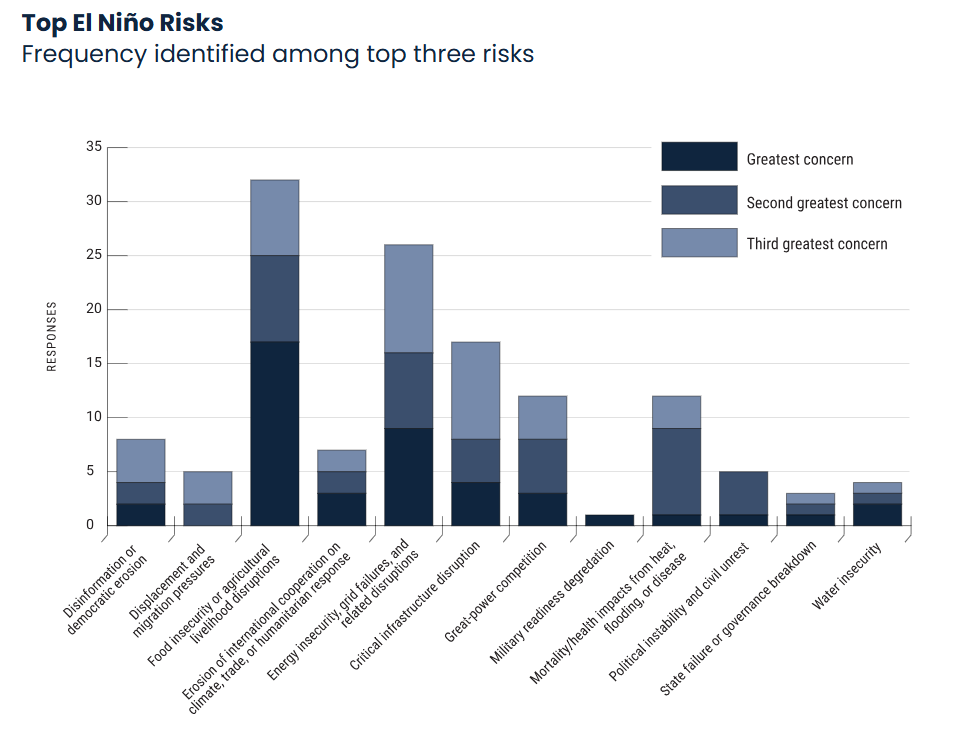
A number of recent reports and data shed further light on the increasing food insecurity around the world. A June report by the Council on Strategic Risks focuses on how “Climate change is sharply increasing the risk of crop failures in global breadbaskets, which poses serious threats to Europe, the NATO alliance, and global stability.” A joint FAO-WFP report identifies 13 countries and territories as hunger hotspots where acute food insecurity is likely to worsen over the period – most critically Sudan, South Sudan, Yemen, and Palestine. A new global survey of climate security experts identified food insecurity as the top national security risk at the intersection of El Niño, the Iran conflict, and climate change.
Food system security is also a high concern in the US. A draft Farm Bill has been released for the Senate Agriculture Committee to consider, with some food supply security sections included throughout; its passing remains highly uncertain. This comes as the first outbreak in the US of New World Screwworm has occurred in six decades. Further, a recent RAND report reviews emerging biological, environmental, and societal risk to US crop production.
Policy comment: Food supply is a major near and long term challenge for humanity. And the typical measures during crises – sending aid, adjusting trade routes, waiting the shock out – will not suffice. A cost-effective policy option available to governments is to invest heavily in research and development in core food system science. A range of areas require significant attention: alternative and resilient foods, advanced and low-input agricultural processes, early warning systems for climate and disease risk, and reduced water and energy use. However, European governments have cut funding to CGIAR – the world’s largest publicly funded agricultural research network – by close to 40 per cent since 2019, and US spending on this kind of research has dropped by a third over the past 20 years. Policymakers should treat food-system R&D as a resilience investment with large economic and societal payoff – research has found that public agricultural R&D produces a 10-20x return for every $1 spent.
Governing for peace and safety
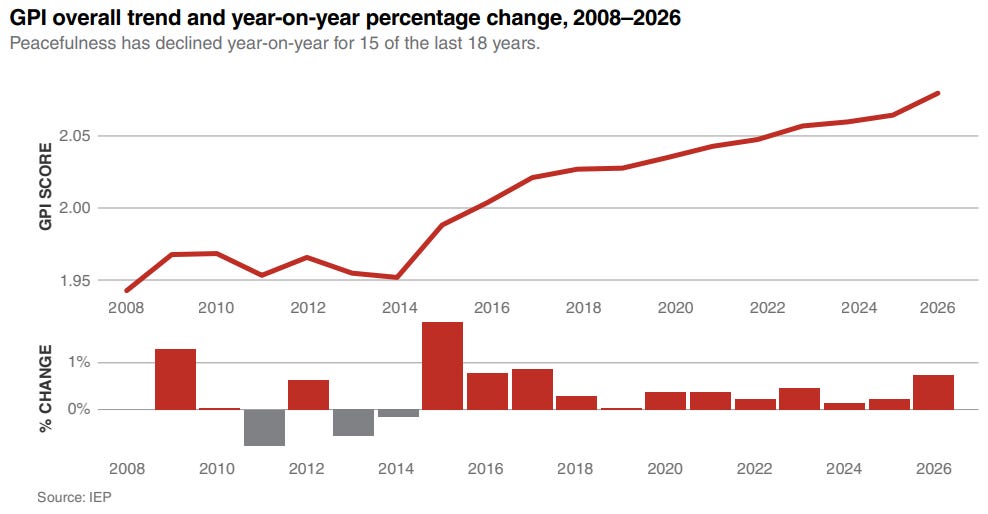
The Institute for Economics and Peace has released the 20th edition of the Global Peace Index, covering 163 countries. Global peacefulness declined for the 12th consecutive year, with 61 active state-based conflicts recorded – the highest since World War II. On 23 June, Lloyd’s Register Foundation launched the World Risk Poll 2026, covering the everyday hazards and safety concerns of ordinary people. The Stimson Center released its Global Governance Innovation Report 2026, tracking implementation of the September 2024 Summit of the Future agreements.
Policy comment: As peace declines, it fosters the conditions for growing global catastrophic risk. It creates points of friction and tension that could conflagrate into regional or global conflicts, while impairing domestic resilience to global threats. However, peace indicators do not help predict how and when catastrophic risk arises. Only in Eastern Europe were war and terrorism named the greatest risk to daily life, according to the World Risk Poll data collected in 2025. All other regions cited road-related accidents, crime and violence and personal health as the highest concerns. This gap – between everyday concerns and global trends in peace and security – requires policymakers to prepare for catastrophic risk in absence of a public attention and mandate. Governments should operate on the assumption that this is not peacetime. They must start building and maintaining institutions capable of managing dangerous situations and catastrophic shocks before they materialize.
On the Radar
Upcoming events and activities that we are tracking.
Ankara NATO Summit
The next NATO Summit will be held in Ankara, Türkiye on 8–9 July. Allies are expected to report topline spending figures for the first time since the Hague Summit pledge to spend 5% of GDP on defence by 2035 – including up to 1.5% to protect critical infrastructure, defend networks, ensure civil preparedness and resilience, unleash innovation, and strengthen NATO's defence industrial base. Global Shield will be tracking the Declaration closely. We are working closely with European critical infrastructure associations to support efforts to build accountability.
Defense Production Act (DPA) reauthorization and modernization by the US Congress.
The DPA’s authorities are set to expire on September 30 unless they are reauthorized by Congress. That makes the coming weeks and months a critical period. Likely Congressional action on the DPA will come in the annual National Defense Authorization Act – and will determine whether the DPA is simply extended as it is currently written, or if Congress takes this important opportunity to modernize and enhance the US government's ability to use the Act effectively during a time of national crisis.
Australia’s AI Policy
Australia’s Prime Minister has flagged major changes to Australia’s AI policy, which could be announced as soon as next month. Inside the governing Labor Party there are increasing calls for greater regulation of AI in contrast to the approach currently being pursued, which relies on existing regulatory frameworks to address AI risk. These changes are expected to focus on data centres and industrial relations, rather than address broader AI risk or catastrophic risk.
This briefing is a product of Global Shield, an advocacy organization dedicated to reducing global catastrophic risk of all hazards. With each briefing, we aim to build the most knowledgeable audience in the world when it comes to reducing global catastrophic risk. We want to show that action is not only needed, it’s possible. Help us build this community of motivated individuals, researchers, advocates and policymakers by sharing this briefing with your networks.