
The latest policy, research, and news on global catastrophic risk (GCR).
How governments see risk and how their publics feel it are two different maps of the same terrain. This edition looks at both: the UK’s National Risk Register, perhaps the most sophisticated public risk assessment in the world, and new polling across seven countries on what people fear most. Neither is a perfect picture. Expert assessments carry embedded assumptions and uncertainty. Public perception is shaped by national culture and personal experience. But governments need both. One approximates the risk itself, while the other reveals the appetite and attention available to act on it. The task is reading them together.
Inside Global Shield
Updates on Global Shield’s work and team.
Global Shield is excited to welcome Inés Parmentier as our new Communications Manager. Drawing on a decade of experience across humanitarian response, food security, and climate resilience within the UN system, Inés specializes in building communications functions from the ground up in active conflict and crisis settings, and translating complex risk narratives for policymakers and the public. Her achievements at the UN World Food Programme (WFP) include leading reporting during the Gaza emergency response, building WFP’s communications presence from the earliest days of the Ukraine crisis in Moldova and leading the communications strategy for WFP's Annual Performance Report across three consecutive cycles. At Global Shield, she will focus on strengthening the organization’s brand voice, media presence, and strategic outreach in support of its advocacy mission.
NATO
Global Shield’s NATO Office has coordinated and released a first-of-its-kind joint statement on improving resilience across NATO from four different critical infrastructure associations representing separate sectors across Europe: Connect Europe (telecommunications), Eurelectric (power), EurEau (water), HOPE (hospitals and health care). This effort is part of Global Shield’s advocacy on NATO Allies’ commitment to spending 1.5% of GDP on defense-related initiatives, such as critical infrastructure security. At the leaders’ summit in Ankara in July, NATO reported that Allies had collectively reached 1.4% of GDP, and are on track to reach 1.45% in 2027. However, considerable uncertainty remains on how this money is being spent to achieve NATO policy and operational objectives, particularly in achieving NATO’s seven Baseline Requirements for resilience, which would also provide resilience for numerous global catastrophic threats.
Australia
Global Shield Australia made a submission to the Australian Government’s consultation on modernizing Australia’s Security of Critical Infrastructure (SOCI) Act. Global Shield Australia supports the overall package of proposed reforms and our recommendations reflect two key themes. First, that the SOCI Act must keep pace with artificial intelligence (AI) as a growing threat enabler to, and potential source of vulnerability within, critical infrastructure assets. Second, that the SOCI Act should better prepare Australia for both routine disruptions and catastrophic crisis scenarios, when continuity of essential services will be key to national resilience. The Australian Office is also hosting a briefing for Australian parliamentarians on the SOCI Act, including how it can be made more effective in protecting Australia’s critical infrastructure and improving Australia’s overall preparedness and resilience.
Under the lens
A closer look at a GCR policy matter
Communicating national risk in the UK
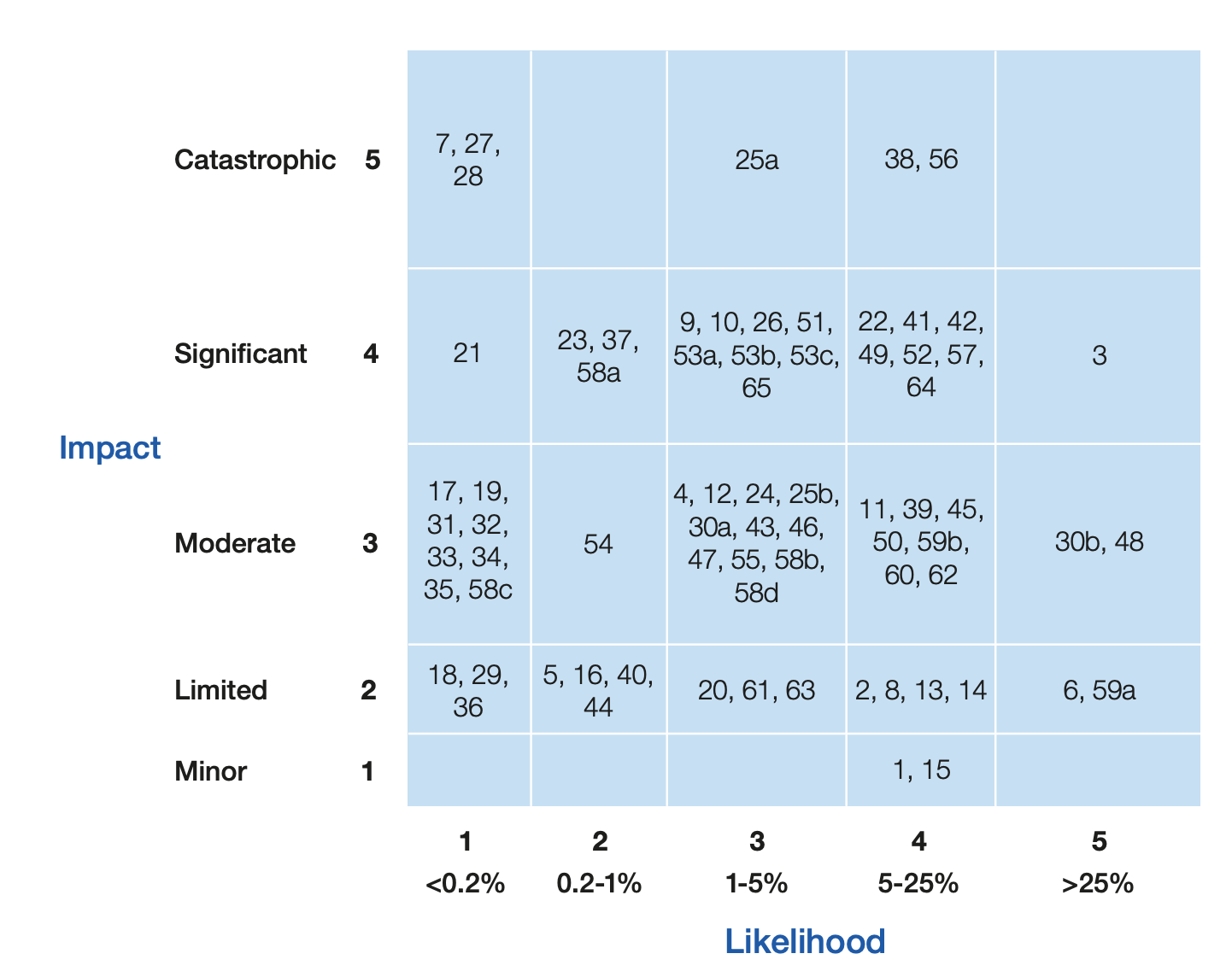
In July 2026, the UK Government delivered its “Annual Statement on National Resilience” to Parliament, summarising the state of national preparedness and the government’s progress over the past year. This statement included an implementation report on its Resilience Action Plan, and the 2026 edition of its National Risk Register.
The 2026 Implementation Report outlines a wide range of actions taken since the plan’s release. These include: a National Security Risk Assessment; Nature Security Assessment; an independent assurance program to test Government preparedness; an audit of the National Capabilities Assessment; a new Crisis Management Excellence Programme for senior officials; and Exercise PEGASUS, the largest national pandemic exercise in UK history.
The 2026 edition of the National Risk Register outlines 95 risks, defined by “reasonable worst-case scenarios”. The following were assessed as at least 5% likelihood (in the next two years for malicious threats and five years for non-malicious threats) and “significant” impact or greater (such as over 200 fatalities or 1 billion pounds in economic loss): Pandemics and outbreak of an emerging infectious disease; failure of water infrastructure; terrorist attacks in publicly accessible locations; accidental or deliberate disruption to space-based services; national disruption to data infrastructure; digital resilience failure; severe space weather; low temperatures and heavy snowfall; national power outage. Failure of water infrastructure moved from a negligible risk in the previous edition to one of the highest. Digital resilience failure was a new entry, and immediately rated among the highest concerns.
Policy comment: The UK’s National Risk Register (NRR) might use the world’s most sophisticated risk assessment methodology for a public government effort at assessing risk of national significance. A number of methodological decisions support a strong analysis across the wide variety of threats covered. But that level of analysis requires careful and nuanced translation for the audience. For example, each risk – plotted on a classic ‘likelihood-impact’ matrix – also receives a confidence rating that shows the extent to which the plotting is subject to uncertainty. Also, the threats are based on acute events. Slow-building or complex risk factors – like artificial intelligence, climate change, fragility in global supply chains – are assessed in a separate “Chronic Risks Analysis”. The attempt to show the comprehensive nature of the analysis can be difficult for the various audiences to digest, especially those outside government who might not have the benefit of classified briefings and risk awareness.
Ultimately, a national risk assessment should help prioritize and inform action – for policymakers, regional or community leaders, first responders, business executives, critical infrastructure providers and the public. Therefore, in support of these detailed analyses, the government should develop separate communications methods for different audiences. For example, interactive risk tools could help communities and households play with the assessment to meet their context. Critical infrastructure providers might need specialized briefings to understand factors of concern or sectors most vulnerable to inform their own risk assessments. Parliamentarians might need short briefings explicit about what changed since the last edition and why. Each format is an opportunity to articulate the subjectivity and uncertainty embedded within the analysis. The risk assessors can only interpret so much. It’s up to the audience to turn the findings into actionable plans for their specific purposes.
Dissecting public perceptions of global threats
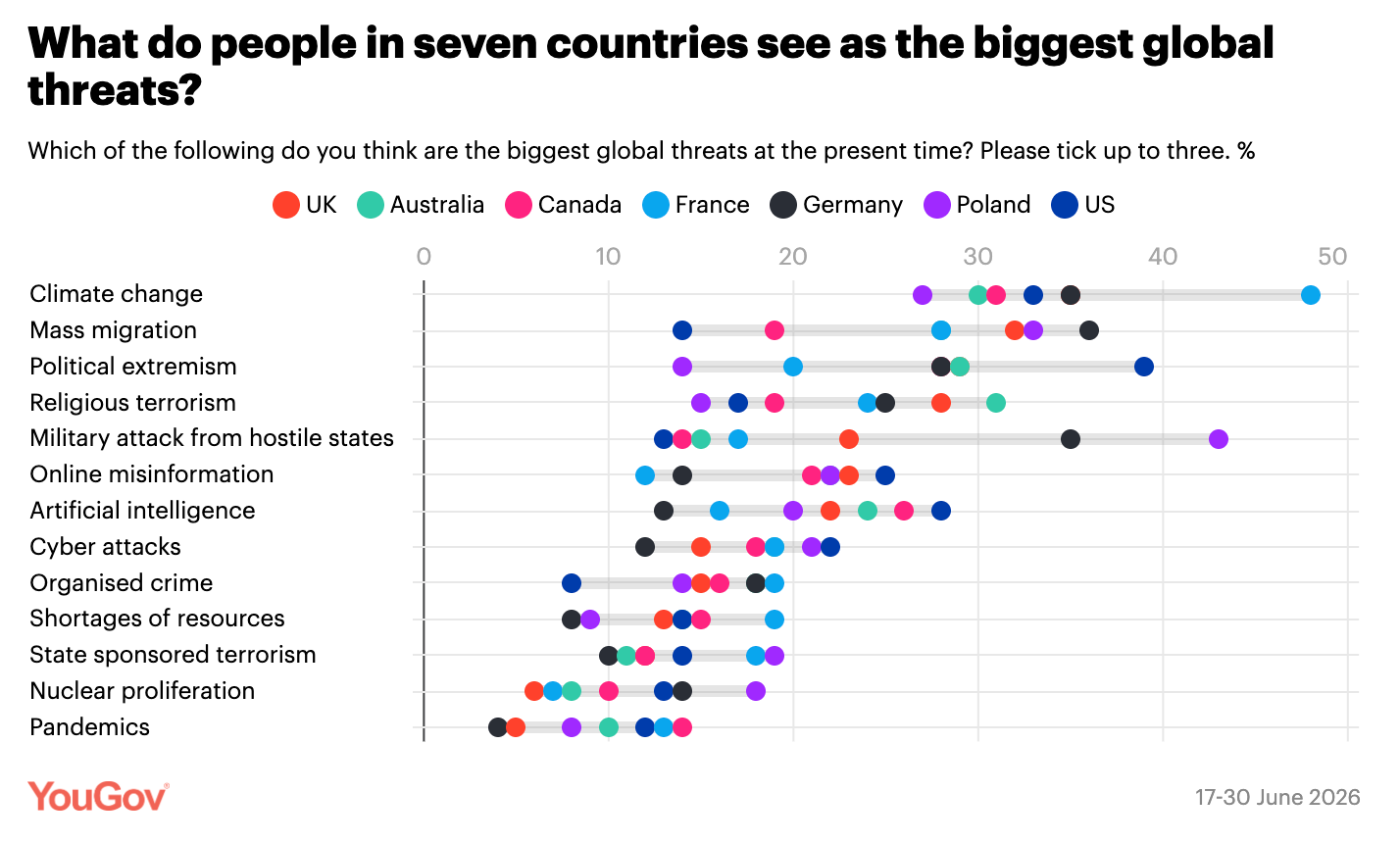
Global polling organization, YouGov, has conducted a poll across the UK, Australia, Canada, France, Germany, Poland and the US on a range of international security issues. Among other questions, respondents were asked which three global threats they would rank as the biggest at the present time. Climate change ranks highest on average. In the US, political extremism was first (39%), then climate change (33%) then AI (28%). In Australia, the top four received very even scoring: religious terrorism, climate, political extremism and mass migration. AI ranked 6th on average, and pipped only marginally by military attack and religious terrorism.
Germany has a seemingly anxious public, having substantial attack fear (34% likely) paired with by far the lowest confidence that its armed forces could repel one (70% were not confident). Meanwhile, Poland was worried about an attack from a hostile state, but seemed relatively calm, given around half said defence spending was already about right – and only 29% wanting more. The US focused inwards. Political extremism (39%) was its top threat, with fear of misinformation and AI also elevated, while external fear was minimal. Australia was least concerned by an attack (22% saying “very unlikely”), has no single consensus fear, and the strongest faith in alliances (91% important).
Policy comment: Across the US and six of its strongest allies, there are strong divergences on public perception of global threats and the security of the global order. Climate change as the top global threat received some level of consensus. Otherwise, views on matters of international security were mixed. Public opinion about global threats is derived from a combination of geopolitical environments, domestic politics and national culture, as well as individual heuristics and biases, like recency bias. It is a useful barometer for how the public feels about risk of national significance. But it can also be divorced from the real level of risk. For example, nuclear proliferation and pandemics ranks last. This perception contrasts with nuclear experts, who are increasingly concerned by the growing nuclear risk and destabilizing strategic dynamics. And the little concern for pandemics is potentially a level of complacency after the world appeared to navigate COVID-19. That such divergences exist between public perception and the reality of risk should trigger two actions from policymakers. First, the government can do its own public survey of risk perception with more rigorous methodology and interpretation. For example, the UK is conducting a public survey of risk perception, resilience and preparedness, to be released in August. Second, as noted in the previous section, other approaches to risk assessment that do not rely on public perception can help more closely approximate the real level of risk. Together, they help governments deliver and communicate their risk management efforts.
On the Radar
Upcoming events and activities that we are tracking.
Implementation of Critical Entities Resilience (CER) Directive
By 17 July 2026, the Member States of the European Union (EU) must have formally identified and designated critical entities operating within their territories, as required by the 2022 Critical Entities Resilience (CER) Directive. Once notified, designated entities have ten months to conduct a risk assessment covering supply chains and cross-sector dependencies, document and test a resilience plan, implement security measures, and begin reporting significant disruptions to their national regulator within 24 hours. Implementation is proceeding unevenly across member states and it is not clear which countries have completed this step. Global Shield continues to track the implementation of the CER Directive, particularly given the EU’s overlap in membership with NATO. As discussed above in our briefing, even the conducting of a risk assessment involves many key decisions.
AI legislation and policy
AI policymaking is moving quickly, especially in the context of multiple incidents of AI models breaking out of test environments and hacking into other companies’ systems. In the US, for example, lawmakers have proposed an AI kill switch. Meanwhile, in the EU, the transparency obligations under Article 50 of the EU AI Act (AI-interaction disclosure, synthetic content labelling, deepfake identification) became enforceable on 2 August. In Australia, the National Cabinet – composed of the Prime Minister and the heads of Australia’s States and Territories – will be considering a proposed approach to an “Australian Standards for AI” in August. As an organization focused on all-hazards GCR reduction efforts, Global Shield’s work helps governments address the impact of AI across a range of policy areas, including in the context of critical infrastructure, emergency management, and pandemic prevention.
BWC Verification
Over 17-21 August, the ninth session of the Working Group on Strengthening the Biological Weapons Convention (BWC) is meeting in Geneva. The Working Group was created in 2022 to fix weaknesses in the BWC, particularly the gap in verification, with an end date of 2026. Two outstanding issues are how to verify compliance and how to track advances in science and technology. The Working Group’s findings are passed to the treaty’s Tenth Review Conference, likely in 2027. Although not a primary focus, Global Shield tracks progress in multilateral efforts where catastrophic risk can be monitored, assessed and reduced, and their potential impact on countries where we have a presence.
This briefing is a product of Global Shield, an advocacy organization dedicated to reducing global catastrophic risk of all hazards. With each briefing, we aim to build the most knowledgeable audience in the world when it comes to reducing global catastrophic risk. We want to show that action is not only needed, it’s possible. Help us build this community of motivated individuals, researchers, advocates and policymakers by sharing this briefing with your networks.